

tree
Definition
A tall plant with a thick wooden trunk, branches, and leaves; a diagram with branching structure showing relationships
To remember it
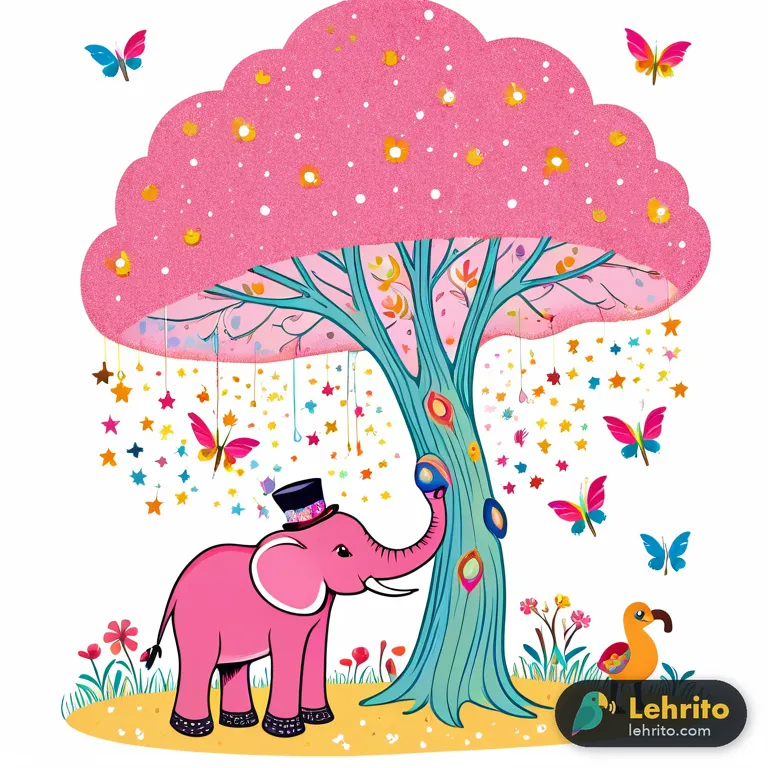
Picture the pink elephant under the tree, and remember that trees are like big umbrellas in nature.
Examples
- A1
There is a big apple tree in our garden that produces hundreds of apples every autumn, and we make juice, jam, and pies from the fruit so that nothing goes to waste.
- A1
The children love to climb the old oak tree in the park because it has very wide branches that are easy to reach and make a perfect place to sit and look out over the surrounding gardens.
- A2
In many countries, cutting down a tree without permission from the local authorities is against the law, especially in protected areas, because trees are important for the environment and take many years to grow to a significant size.
- A2
The family created a family tree to map out all their ancestors and discover how different branches of the family were related, going back several generations and including names, dates, and places of birth for each person.
- B1
The Amazon rainforest contains an estimated four hundred billion trees belonging to around sixteen thousand different species, and together they play a crucial role in regulating the global climate by absorbing vast quantities of carbon dioxide from the atmosphere and releasing oxygen through photosynthesis.
- B1
Urban trees provide important environmental services that are often underappreciated: they shade buildings and reduce air conditioning costs in summer, absorb stormwater that would otherwise overwhelm drainage systems, filter air pollutants, reduce the urban heat island effect, and provide habitat for birds and insects that would otherwise be absent from city environments.
- B2
The data structure known as a "tree" in computer science — a hierarchical structure consisting of nodes connected by edges, with a single root node from which all other nodes descend through parent-child relationships, with leaf nodes at the bottom having no children — underpins a vast range of computational tasks including search algorithms, database indexing, file system organisation, compiler design, and machine learning models such as decision trees and random forests.
- B2
Dendrochronology — the scientific dating technique that analyses tree rings to determine the age of wood and reconstruct historical climate patterns — exploits the fact that trees form one new growth ring each year, with wider rings forming in years with good growing conditions and narrower rings forming in years with drought or cold, allowing scientists to build continuous chronologies extending thousands of years and providing an important independent check on radiocarbon dating and other chronometric methods.


