

moon
Definition
The natural satellite of the Earth, visible by reflected light from the Sun; any natural satellite of a planet
To remember it
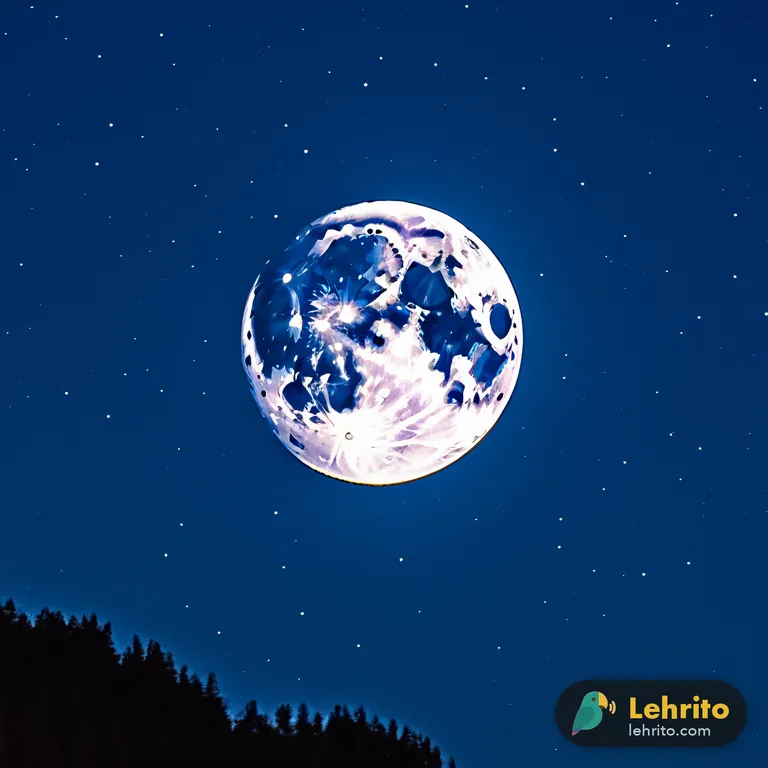
Picture the glowing, round object in the night sky. It's the Moon!
Examples
- A1
The moon was so bright last night that you could see clearly without any artificial light, and the children wanted to stay up late to look at it through the telescope in the garden.
- A1
On 20 July 1969, Neil Armstrong became the first human to walk on the surface of the Moon, saying the famous words about a small step for man and a giant leap for mankind as he stepped off the lunar module.
- A2
The full moon rises in the east at sunset and sets in the west at sunrise, completing its cycle of phases — from new moon through crescent, half, gibbous, and full moon and back again — over the course of approximately twenty-nine days.
- A2
The gravitational pull of the Moon is the primary cause of the tides that raise and lower the sea level at coastal locations twice each day, with the highest tides occurring when the Moon, Earth, and Sun are aligned and their gravitational effects on the oceans combine.
- B1
The mythology and folklore surrounding the Moon is extraordinarily rich across cultures: in many traditions the Moon is associated with femininity and cyclical time (because its monthly cycle echoes the menstrual cycle), with water and the tides it governs, with madness and altered states of consciousness (the word "lunatic" comes from "luna"), with the underworld and the realm of the dead, and with the mysterious, unpredictable forces that govern human fate and emotion.
- B1
The scientific understanding of the Moon's formation has converged on the giant impact hypothesis: approximately 4.5 billion years ago, a Mars-sized planetesimal called Theia collided with the early Earth at an oblique angle, ejecting enormous quantities of vaporised rock into Earth orbit that eventually coalesced under gravity to form the Moon, explaining the Moon's composition (similar to the Earth's mantle), its lack of a substantial iron core, and its relatively low density compared to Earth.
- B2
The question of whether humanity should return to the Moon and establish a permanent presence there has become one of the most contested policy questions in space exploration, with proponents arguing that the Moon offers valuable resources (including water ice at the poles that could be used for life support and rocket propellant), serves as a proving ground for deep space technologies and long-duration habitation systems, and represents a strategic frontier whose development confers national prestige and economic advantages.
- B2
The poetic tradition has used the Moon as one of its richest and most consistent symbolic resources: the Moon's association with beauty, change, and distance has made it a natural vehicle for expressing longing, romantic feeling, and melancholy; its association with light in darkness has made it a symbol of hope, reason, or divine guidance; and its cyclical waxing and waning has made it a symbol of time, mortality, and the rhythmic alternation of life and death.


