

eye
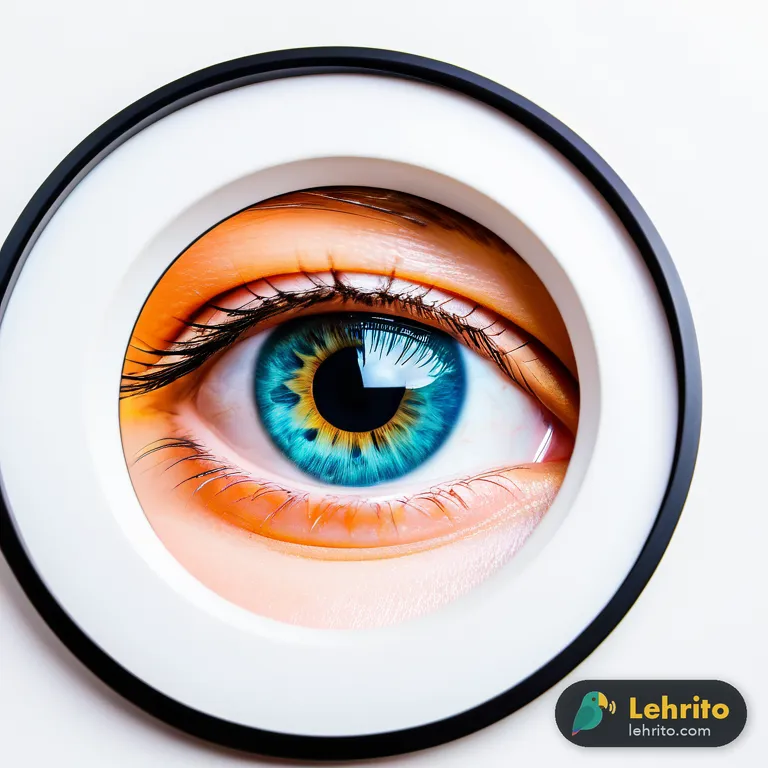
Definition
The organ of sight in animals
To remember it
Picture the human eye in a circular frame. Think of how the round shape represents the iris and pupil, making it easy to remember 'Eye'.
Examples
- A1
She has beautiful blue eyes that sparkle when she laughs.
- A1
Close your eyes and count to ten while I hide the surprise.
- A2
The doctor examined his eyes carefully and prescribed new glasses.
- A2
She kept her eyes on the road and both hands on the steering wheel.
- B1
The human eye is often compared to a camera — with the cornea and lens focusing light, the iris regulating how much light enters, and the retina acting like film — but this analogy breaks down in important ways: unlike a camera, the eye is in constant motion, the retina processes information rather than merely recording it, and the visual system actively constructs perception rather than passively receiving images.
- B1
The idiom "eye contact" — the social act of looking directly into another person's eyes during conversation — carries significant cultural variation in meaning: in many Western cultures, maintaining eye contact signals attention, honesty, and respect, while avoiding it may suggest dishonesty or lack of confidence; in some East Asian and many African cultures, however, prolonged eye contact with elders or authority figures can be seen as disrespectful or confrontational.
- B2
The evolution of the eye — once cited by Darwin himself as a seemingly insuperable challenge to his theory of natural selection — is now one of the best-documented examples of evolutionary transition: complex camera-like eyes have evolved independently at least 40 times in different animal lineages, and each intermediate stage (from a light-sensitive patch of cells, to a cup, to a pinhole, to a full lens-and-retina eye) is advantageous, making the gradual evolution of the eye fully compatible with natural selection.
- B2
The "all-seeing eye" or Eye of Providence — familiar from its appearance on the US dollar bill — is a symbol with complex religious and political history, originally representing the eye of God watching over humanity in Christian iconography, adopted by Freemasons, and later incorporated into American national symbolism; it has also become a popular symbol of surveillance and conspiracy in contemporary culture, illustrating how symbols change meaning as they move across cultural contexts.
Synonyms
Tags


