
book
Definition
A written or printed work consisting of pages bound together
To remember it
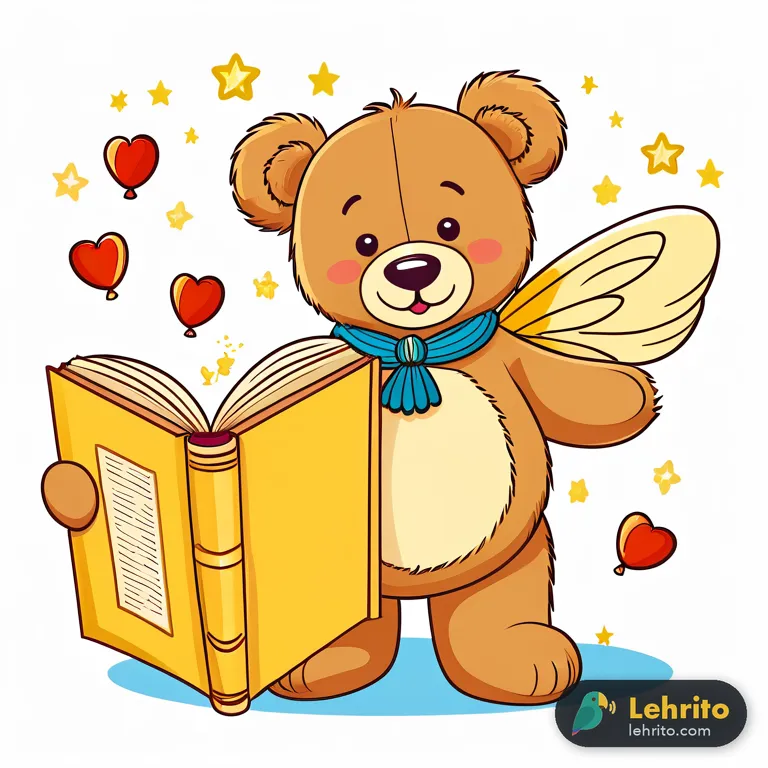
Picture the cute teddy bear holding a yellow book with hearts floating around it. Think of how books can be magical and full of stories, just like the teddy bear is holding a book with hearts.
Examples
- A1
I love reading books — I usually finish one or two every week because I read on the train to work.
- A1
Can you book a table for four people at the Italian restaurant for Saturday evening at eight o clock please?
- A2
The library has over a million books and you can borrow up to ten of them at a time with your library card.
- A2
She booked her flights and hotel three months in advance to get the best prices for her vacation.
- B1
The history of the book: the codex (book with pages) replaced the scroll in the early centuries CE; the Gutenberg movable-type printing press (c. 1440) revolutionized book production, making books affordable and accessible; before printing, books were hand-copied by monks in scriptoria; the incunabula (books printed before 1501) number about 27,000 surviving copies; the Renaissance was fueled by the wider circulation of classical texts made possible by printing; mass printing led to the Protestant Reformation (Luther Bible, widely distributed pamphlets); the novel emerged as the dominant literary form in the 18th-19th centuries; the 20th century brought paperback books, audiobooks, and now e-books.
- B1
Booking systems and online reservations: the modern travel and hospitality industry relies on online booking systems; online travel agencies (Expedia, Booking.com, Airbnb) disrupted traditional travel agents; hotel and airline yield management uses algorithms to dynamically price rooms and seats based on demand; overbooking (selling more reservations than capacity, expecting some cancellations) is common in airlines and hotels; the 2017 United Airlines incident where a passenger was forcibly removed from an overbooked flight attracted global attention; no-show penalties and cancellation policies balance the interests of service providers and customers; the shift to digital booking has reduced friction and increased price transparency.
- B2
The book publishing industry: book publishing is a multi-billion dollar global industry; the Big Five publishers (Penguin Random House, HarperCollins, Simon and Schuster, Hachette, Macmillan) dominate trade publishing; literary agents serve as gatekeepers between authors and publishers; the advance (money paid to an author before a book is published) must be earned back through royalties before additional payments are made; self-publishing has expanded dramatically through Amazon KDP and similar platforms, allowing authors to bypass traditional gatekeepers; e-books and audiobooks have grown rapidly while print persists; the bestseller list (New York Times, etc.) shapes sales through the virtuous cycle of exposure.
- B2
Book banning and censorship: throughout history, books have been banned, burned, or restricted by authorities who found them threatening; the Index Librorum Prohibitorum (Index of Forbidden Books) of the Catholic Church listed books Catholics were forbidden to read (1559-1966); Nazi book burnings (1933) targeted books by Jewish, communist, and politically undesirable authors; in the Soviet Union, samizdat (self-publishing) allowed underground circulation of banned books; in the US, the American Library Association tracks book challenges and banning; the most frequently challenged books include To Kill a Mockingbird, The Catcher in the Rye, Harry Potter, and The Absolutely True Diary of a Part-Time Indian; book banning is often justified as protecting children from age-inappropriate content.
Synonyms
Antonyms
Tags


